

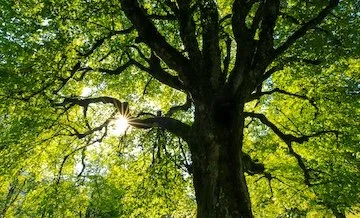
The leaves of the tree are for the healing of the nations. — Revelation 22:2
After she was diagnosed with breast cancer in 2019, Helen Anahita Wilson began pondering the origins of the medicine entering her body. She was surprised to learn that many chemotherapy and anti-cancer drugs are derived from plants, and that discovery changed the way she viewed the infusion room: Behind the IV bags, medical language, and machinery was a living world of leaves, bark, petals, branches, and roots.
As a composer and musician, Wilson began wondering whether those plants could be heard. So she went to the oncology section of Chelsea Physic Garden in London and recorded the natural bioelectricity of plants used in cancer treatment.
She gathered 28 recordings from petals, leaves, trunks, and branches, then converted those plant signals into musical data. Each plant produced its own patterns of pitch and rhythm: Petals tended to be active and varied, while branches and trunks often moved more slowly, creating drone-like textures.
Wilson then assigned instruments to the recordings. For example, the petals of the Madagascan periwinkle (used to treat Hodgkin's lymphoma) became harp; the bark of the English yew (used for chemotherapy drugs for breast and ovarian cancer) became viola; and opium poppy (used for cancer pain management) triggered field recordings of birdsong and rain. Out of these living signals, Wilson composed a 45-minute piece called Linea Naturalis -- Latin for “the natural line.”
The length is intentional, Wilson says: 45 minutes is roughly the amount of time it takes for the contents of a chemotherapy drip bag to enter the body. Wilson created the piece especially for people receiving cancer treatment, offering them a way to feel connected to creation while sitting in an environment that can feel painfully unnatural.
In Wilson's view, plant signals becoming musical notes and the oncology garden entering the hospital room through harp, viola, birdsong, and rain are all part of the beauty that surrounds us. In the valley of illness, creation bears witness to the God who knows us and meets us in very practical ways.
God's story begins in a garden, and Scripture ends with an image of healing that is also botanical: In Revelation 22, John sees the river of the water of life flowing from the throne of God. On either side of the river stands the tree of life, and we are told that “the leaves of the tree are for the healing of the nations.”
For anyone walking through illness, grief, or uncertainty, Wilson’s work reminds us that healing sometimes comes through medicine we barely understand, through music that helps us breathe, through creation singing quietly beneath the surface of things.