

“The heavens declare the glory of God; the skies proclaim the work of his hands.” -- Psalm 19:1
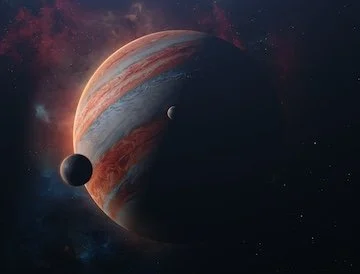
Forty-nine light-years from Earth, a planet called LHS 1140b is giving astronomers new reason to look toward the sky.
The planet is about five times the mass of Earth, placing it in a category scientists call a “super-Earth.” It appears to be predominantly rocky, with an iron core and silicate mantle, and it orbits its star within the habitable zone, also called the "Goldilocks zone." Scientists believe the planet's temperature may allow liquid water to exist on its surface, and now scientists have detected promising signs that LHS 1140b may also possess an atmosphere.
That possibility matters because a rocky surface, moderate temperatures, and an atmosphere are three of the primary ingredients scientists seek when evaluating whether a distant planet could potentially support life.
LHS 1140b was first discovered in 2017. Its host star is a red dwarf, the most common type of star in the universe. Red dwarfs are smaller and cooler than our sun, making nearby planets easier to observe. They are also highly active, emitting radiation that can heat planetary atmospheres and eventually strip them away.
For that reason, many astronomers have wondered whether rocky planets orbiting red dwarfs can retain atmospheres at all.
Planetary scientist Collin Cherubim and his colleagues may have found an encouraging example. Using the Magellan Clay telescope at Las Campanas Observatory in Chile, the research team detected helium escaping from LHS 1140b in September 2024. The finding suggests that the planet may once have had an atmosphere rich in hydrogen and helium. Over time, most of the lighter hydrogen may have escaped into space while some of the heavier helium remained.
The result is exciting, but it is not yet conclusive. During follow-up observations in 2025, scientists could no longer detect the helium. Its rate of escape may have fallen below the telescope’s sensitivity, but researchers acknowledge that the discrepancy remains a mystery. Additional observations are planned using some of the world’s most powerful instruments, including the James Webb and Hubble space telescopes.
Scientists will search for water vapor, oxygen, and other gases that could reveal more about this distant world. Each observation may produce an answer, another mystery, or an entirely new set of questions.
And isn't that the gift of exploration? The more deeply we examine God's creation, the more we discover how much remains beyond our sight. A faint signal from a planet 49 light-years away can remind us that the universe is still unfolding before us -- vast, intricate, and filled with wonders we have barely begun to perceive.
The Heavens Still Declare
Previous
Previous
Put a Little Joy in Your Tank
Next
Next