

Unicorns Beneath the Ice
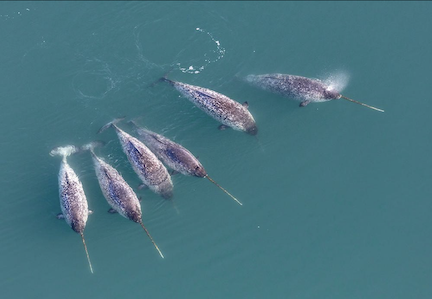
If you have ever wondered whether creation still holds the power to surprise us, meet the narwhal.
Their mottled gray bodies can reach 16 feet or more, and males often carry a single spiraling tusk that extends another 6 to 10 feet from the head. The tusk is not a horn at all but an elongated tooth, growing in a left-handed spiral through the whale’s upper lip. That extraordinary feature has earned narwhals their familiar nickname: the unicorns of the sea.
And this summer, six narwhals became something even more remarkable: research assistants.
Narwhals spend much of their lives in Arctic waters that are extraordinarily difficult for humans to reach. In East Greenland’s Scoresby Sound -- the largest fjord system in the world -- sea ice, icebergs, deep water, and remote geography can stall research vessels long before scientists reach the places they most want to measure.
Narwhals, of course, already live there.
Between 2017 and 2020, local hunters helped researchers from the Greenland Institute of Natural Resources, the University of Copenhagen, and other institutions temporarily equip six narwhals with satellite-transmitting sensors. The instruments measured water temperature, salinity, and depth during the animals’ normal dives. Each sensor remained attached for anywhere from 85 to 332 days. Together, the whales supplied 2,060 oceanographic profiles, some from depths greater than 1,500 meters, which is nearly a mile beneath the surface.
The result was a view of the Arctic that ships have never been able to provide.
About 186 miles inside the fjord system, the narwhals detected warmer, saltier Atlantic water reaching deep beneath the colder polar water above it. When researchers combined those readings with more than a century of historical measurements, they found that the layer of Atlantic water has been growing thicker while the colder polar layer has been growing thinner. That warmer water can reach the fronts of Greenland’s glaciers and contribute to their melting.
Narwhals can travel where our ships cannot. They can dive where we cannot breathe. They navigate darkness, pressure, ice, and water temperatures hovering near freezing as an ordinary part of being what God made them to be. And in doing so, six “unicorns of the sea” have now shown us something about a corner of the planet that we could not see for ourselves.
The more we learn about creation, the larger it seems to become. A fjord stretches hundreds of miles beneath Greenland’s mountains. Warm Atlantic water moves invisibly beneath Arctic ice. A whale descends nearly a mile into darkness carrying a spiraled tooth on its head, and -- for a brief period -- a tiny scientific instrument on its back.
We know more about this world than any generation before us, and still creation keeps handing us reasons to marvel.
As Psalm 104:24 reminds us:
How many are your works, LORD!
In wisdom you made them all;
the earth is full of your creatures.
As you move through your week, watch for narwhal-moments in the world around you. If you are open to it, sometimes the smallest glimpse into creation leaves us with the largest sense of our Creator.