

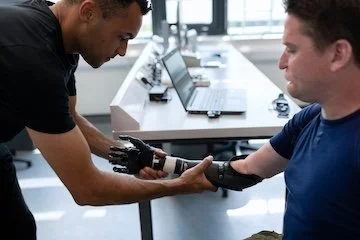
In 2008, Kiko Trujillo answered a phone call that would change the trajectory of his life. A pediatrician from Tucson, Arizona, named Dr. Duke Duncan was looking for someone across the border in Nogales, Mexico, who could help provide all-terrain wheelchairs to people with disabilities. Trujillo, an industrial engineer with deep roots in his community, was baffled. “I don’t know anything about medical equipment,” he told Duncan. But he agreed to help, with one condition: He would commit to the project for seven years.
Eighteen years later, Trujillo is still at it.
Together, Trujillo and Duncan founded Arizona Sonora Border Projects for Inclusion (ARSOBO), a nonprofit that provides customized wheelchairs, prosthetic limbs, hearing aids, and rehabilitation services to low-income families on both sides of the U.S.-Mexico border. What began with rugged “Rough Rider” wheelchairs designed to navigate uneven terrain has grown into an operation that has served nearly 3,500 people from 97 cities across 10 Mexican states.
The numbers tell an impressive story: more than 820 all-terrain wheelchairs constructed, 900 prosthetic and orthotic devices fabricated, and 740 hearing aids distributed. In 2016, the organization partnered with the University of Arizona to begin offering monthly hearing clinics. More recently, ARSOBO moved into a larger facility and began offering free physical therapy to help amputees adjust to their new prosthetics.
And one of the most remarkable features of ARSOBO is its workforce. Trujillo deliberately hires people with disabilities to manufacture the very devices they themselves use. The technician building a prosthetic leg, for example, is someone who wears one. When a newly injured patient arrives feeling devastated about losing a limb, that technician can offer something no medical textbook can provide: firsthand evidence that life can still be full and meaningful.
More than 20 people with disabilities have been trained and employed through the program. Patients pay what they can, when they can. And Trujillo insists that nobody leaves without the equipment they need.
Consider Paul's description of the church in 1 Corinthians 12, where he reminds us that every part of the body matters and that those parts we might consider weaker are actually indispensable. ARSOBO brings that truth to life in a beautifully practical way: People who arrive seeking assistance discover that their experiences equip them to become the very people who offer assistance to others.
Duncan, now 93, laughs about Trujillo's original seven-year commitment. What began as a temporary project became a calling that neither man could have anticipated.
Isn't that often how God works in our lives? We agree to help with something small, even something outside our expertise, and we discover along the way that we've been invited into something much larger. Listen well for the Holy Spirit's whisper, Friends, as sometimes the most meaningful work of our lives begins with an unexpected invitation and a willingness to say yes.