

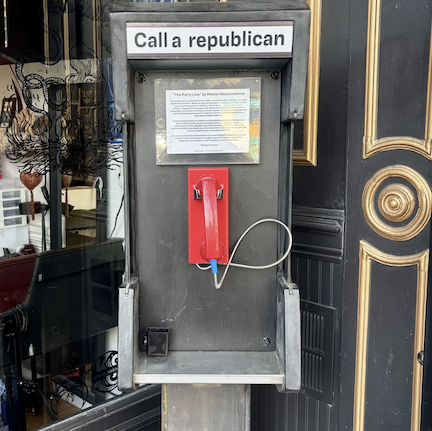
Two old-fashioned payphones, installed roughly 1,500 miles apart, have become the unlikely centerpiece of an experiment in bridging America's political divide.
One, painted red, stands outside Black Serum Tattoo in San Francisco's famously liberal Mission District. The other, painted blue, stands outside Seven and One Books in Abilene, Texas -- one of America's most conservative communities. The red phone invites passersby to "Call a Republican," while the blue phone invites them to "Call a Democrat."
"The Party Line" is an experiment launched earlier this year by Colorado-based Matter Neuroscience. Researchers purchased two battered payphones on Facebook Marketplace, refurbished them, and programmed each to call the other automatically. The calls are free. All someone has to do is pick up the receiver and hope a stranger answers.
The researchers weren't sure what to expect. Neuroscientist Axel Bouchon worried that putting political opponents on the phone together would produce angry confrontations or even vandalism. His business partner, entrepreneur Ben Goldhirsh, was more optimistic. He suspected that people might discover they had more in common than their political affiliations suggested.
The results, first reported earlier this month, have been a surprise in this curious age of anxiety.
Over the course of roughly 400 conversations, researchers found that 80% were positive and only 5% were negative. More than half included laughter, and approximately 70% featured some expression of agreement or affirmation. The word "love" appeared 398 times, compared with just 64 mentions of "Trump."
The conversations themselves also proved fascinating. Jared, calling from Texas, struck up a conversation with Ben in San Francisco. They began by talking about the weather, then moved to books, travel, and the things they wanted from life. Jared described his book club and his longing to travel more. Ben admitted that living in San Francisco had insulated him from much of the rest of America. Their conversation lasted just seven minutes.
In another call, a Texas mother confided to a stranger in California that she had a transgender child, something she felt uncomfortable discussing openly in her own community. Another pair bonded over motorcycles. Others discussed their jobs, families, housing costs, and other everyday concerns. Most weren't interested in fighting. They were interested in being heard.
The experiment was so encouraging that Matter Neuroscience expanded the idea. Another pair of phones connected Boston University students with older adults at a senior living community in Reno, Nevada. One conversation brought together a 20-year-old student named Sylvie and a 66-year-old woman named Valerie, who spoke about grief and the unexpected loss of her longtime partner. A third experiment connected residents of affluent Venice, California, with people in the lower-income Watts neighborhood of Los Angeles.
What began as an experiment in political polarization became something larger: a demonstration of what can happen when people are given an opportunity to connect beyond the labels that ordinarily separate them.
"Everyone should be quick to listen, slow to speak and slow to become angry," James 1:19 reminds us. It's a verse that can seem particularly challenging in a time when political disagreements so easily become personal hostilities.
We encounter people every day whose experiences, assumptions, and convictions differ from our own. The challenge is whether we're willing to approach those conversations with curiosity, allowing someone else's story to complicate the easy categories we've created.
When communication seems challenging this week -- particularly as the midterm elections loom -- what if we keep the Party Line experiment in mind? Picture the payphones. Because sometimes it's as simple as remembering that on the other end of every conversation is another human being with a life every bit as complicated and meaningful as our own.