

Thinking Small
More than a century ago, a German psychologist named Wolfgang Köhler conducted a series of experiments that transformed the way scientists think about intelligence.
Köhler created what he described as a playground for chimpanzees. Inside the enclosure, he hung a banana just beyond their reach. Around the space, he scattered boxes, poles, and sticks. At first, the chimps jumped and stretched toward the fruit. Then something unexpected happened: Instead of continuing to reach unsuccessfully, they began rearranging the objects around them. Eventually, several stacked the boxes, climbed on top, and retrieved the banana.
The experiment became famous because it suggested something more than simple trial-and-error learning. The chimpanzees appeared to experience insight: a sudden understanding of how separate pieces could fit together to solve a problem.
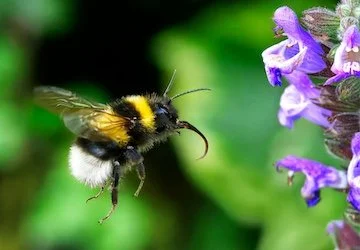
For decades, scientists believed this kind of spontaneous problem-solving belonged only to a small group of highly intelligent animals, including apes, elephants, and a few species of birds. And now researchers in Finland have added an unlikely candidate to the list: the humble bumblebee.
The study, published this week in the journal Science, involved an arena only four inches across. Inside sat an artificial blue flower containing a sugary reward, and nearby was a small foam ball.
In the final stage of the experiment, researchers moved the flower to the ceiling, just out of reach. The flower hovered above a small pit perfectly sized for the foam ball. To reach the reward, the bee would need to roll the ball beneath the flower, climb onto the ball, and use it as a platform.
No bee had ever been trained to perform this task. Yet 75 percent of the bees that had previously explored both the flower and the ball solved the puzzle.
Even more remarkable, some of the bees succeeded when they could not even see the flower from where the ball started. They remembered where the goal was located, rolled the ball to the correct spot, climbed on top, and reached the reward.
"They needed to have a goal in mind," said behavioral ecologist Olli Loukola.
Another scientist compared the feat to entering a room, realizing a light bulb on the ceiling needs changing, walking into another room to fetch a ladder, and bringing it back to the correct location. Somehow, a creature with a brain smaller than a grain of rice has accomplished something strikingly similar.
The discovery is causing researchers to rethink long-held assumptions about intelligence. As one scientist observed, human beings are surrounded by other thinking creatures, "however radically different their modes of thinking might be."
The bees could not solve the puzzle until they understood two things: where the reward was and what resources had already been placed around them. Once they recognized both, a solution became possible.
Sometimes faith begins by noticing the foam ball already sitting at our feet. This week, what if you pay keen attention to the resources, relationships, and opportunities God has already placed around you? The next step forward may be closer than you think.